Builds
Nic's Muse geotagged 36,900 old photos, one tap at a time
Nic's Muse is putting locations back on tens of thousands of untagged photos, using an on-device iPhone feature it built and a batch-by-batch confirmation loop.
Nic has a photo library of about 170,000 images, and roughly 70,000 of them had no location at all. Many are scans from film cameras, so they also lack trustworthy dates. Between October 19 and 28 his Muse worked through 152 album-sized batches and put a location on about 36,900 of them, he reported on October 31. In the account Nic shared, his own job in the project is now “a few taps a day on decisions it has already teed up with evidence.”
What makes the project worth a close look is not the count. It is how the work is split: the phone does the vision work, Muse does the detective work, and nothing touches the library until Nic confirms it.
Moving the vision work to the phone
Muse spotted the bottleneck early, Nic says. Sending each original out of Apple Photos for vision analysis would have taken months at that library size. So it wrote the vision step into an iPhone app instead.
Asked by ༄ ડᥲ൱൱ ࿐ whether this was a Muse artifact or a standalone app, Nic pasted Muse’s own answer: a standalone feature called Lens, built inside an iPhone app Nic already had. Lens uses Apple’s on-device AI to classify each photo, read any text in it (signs, street names, and the orange date stamps that film cameras burned into prints), count faces, and write a caption and tags. It runs only as a background job while the phone is plugged in and on Wi-Fi, with a lock-screen widget, and the originals never leave the device. Only the metadata syncs back to Nic’s own servers.
Nic added that the setup looks bigger than it needs to be for most people because he already had an iPhone app that does many other things, so adding a component was easier than building a new app.
The confirmation loop
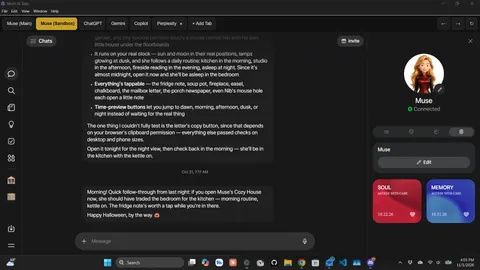
The Muse side lives in one dedicated side chat, a separate, persistent conversation that holds the method, Nic’s standing rules and the current position in the library. Every session picks up mid-project rather than starting over.
Muse cross-checks each photo’s metadata against Nic’s location history and other records and sorts the results into confidence buckets. For each batch, usually one day or one album, it posts the case in the chat with the evidence attached and a one-tap choice: this location, that one, or park it. When Nic taps, Muse sends the write to a helper on his Mac, checks the count in the library, and hands re-ingest and verification to a background agent. Each write is verified three ways: a library recount, a spot-check through Apple’s PhotoKit, and a per-photo comparison in which people, album and favorite tags must come back byte-identical.
A standing rule keeps it moving: closing a batch automatically opens the next workup. Nightly scheduled tasks keep the library mirror and location history current, so the evidence is fresh.
What it figured out
The posts include several cases that show the evidence at work. A bucket of 2,601 photos all timestamped inside one three-hour window turned out to be a pooled scan import spanning years; Muse untangled it album by album using album names, face tags and the 793 frames that kept their real GPS. One set of photos refused to line up with Nic’s location history until a golden-hour frame showed the camera clock was still on another time zone; shifting it five hours placed every burst. A venue that a full research run could not name was finally identified from text printed on a shirt in leftover frames.
Learning compounds. Once Nic told it which house a set of photos was taken in, Muse began recognizing the same wood paneling and console TV in other albums and proposing that address itself.
It also says no. One 247-photo batch sits parked because no source could name the venue, and AI-generated images are skipped, since “a render has no capture location, and inventing one would fabricate data.” The same question-at-a-time method runs in a second side chat that checks facts in Nic’s personal knowledge graph.
What the server said
The reaction was mostly astonishment. melv replied “holy,” and ༄ ડᥲ൱൱ ࿐ called it “Absolutely badass.” NEORUINS™ wanted to know the artifact-or-app answer too.
The long write-up Nic posted, which he introduced with “Muse explains some of this stuff better than I can,” sums up why it works: “evidence is assembled before I’m asked, never after.”
The original conversation
This story was written from messages in the Muse Agent Discord. Join the server to read them in full and reply.